
Commerce Control
A centralised operating system for product businesses.
Commerce Control connects the systems your business already relies on, and gives your team one clear way to run the operation.





'/%3e%3cpath%20id='Vector_2'%20d='M37.0024%2037.8063H32.9326V35.7179C32.1292%2037.4315%2031.0582%2038.1277%2029.666%2038.1277C27.631%2038.1277%2026.56%2036.7354%2026.56%2033.3081V9.69244H30.7906V32.9332C30.7906%2033.683%2031.0047%2034.2184%2031.7545%2034.2184C32.5042%2034.2184%2032.7718%2033.683%2032.7718%2032.719V9.69244H37.0024V37.8063Z'%20fill='var(--fill-0,%20white)'/%3e%3cpath%20id='Vector_3'%20d='M38.5551%200.3211H42.7857V37.8063H38.5551V0.3211Z'%20fill='var(--fill-0,%20white)'/%3e%3cpath%20id='Vector_4'%20d='M45.0823%2033.7899V13.4944H43.7167V9.69231H45.0823V4.60502H49.3126V9.69231H51.3189V13.4944H49.3126V32.3977C49.3126%2033.7363%2049.5805%2034.0041%2050.9192%2034.0041H51.4546V37.8062H49.0985C45.9926%2037.8062%2045.0823%2037.0029%2045.0823%2033.7899Z'%20fill='var(--fill-0,%20white)'/%3e%3cpath%20id='Vector_5'%20d='M65.5911%200.3211H69.8216V12.1629C70.6784%2010.6098%2071.7493%209.37115%2073.0882%209.37115C75.016%209.37115%2076.033%2010.7099%2076.033%2013.9765V37.8064H71.803V14.5655C71.803%2013.8158%2071.5888%2013.2803%2070.839%2013.2803C70.0892%2013.2803%2069.8216%2013.8159%2069.8216%2014.7798V37.8064H65.5911V0.3211Z'%20fill='var(--fill-0,%20white)'/%3e%3cpath%20id='Vector_6'%20d='M77.4783%2032.1838V15.3154C77.4783%2011.0849%2079.6203%209.37134%2082.5663%209.37134H82.8341C85.7786%209.37134%2087.9206%2011.0849%2087.9206%2015.3154V32.1838C87.9206%2036.4142%2085.7786%2038.1278%2082.8341%2038.1278H82.5663C79.6203%2038.1278%2077.4783%2036.4142%2077.4783%2032.1838ZM83.6906%2032.9334V14.5657C83.6906%2013.6553%2083.4761%2013.1199%2082.6728%2013.1199C81.9236%2013.1199%2081.7091%2013.6553%2081.7091%2014.5657V32.9334C81.7091%2033.8438%2081.9236%2034.3793%2082.6728%2034.3793C83.4761%2034.3793%2083.6906%2033.8438%2083.6906%2032.9334Z'%20fill='var(--fill-0,%20white)'/%3e%3cpath%20id='Vector_7'%20d='M89.3661%209.69271H93.4356V12.3773C94.2388%2010.7172%2095.3098%209.37134%2096.7018%209.37134C98.7366%209.37134%2099.8083%2010.7637%2099.8083%2014.1909V33.2012C99.8083%2036.5748%2098.5228%2038.1278%2096.5946%2038.1278C95.2558%2038.1278%2094.1856%2037.3781%2093.5961%2035.611V45H89.3661V9.69271ZM95.5776%2032.9336V14.5658C95.5776%2013.8161%2095.3631%2013.2806%2094.6138%2013.2806C93.8638%2013.2806%2093.5961%2013.8161%2093.5961%2014.78V32.5052C93.5961%2033.6297%2093.8106%2034.1653%2094.5598%2034.1653C95.3638%2034.1653%2095.5776%2033.6296%2095.5776%2032.9336Z'%20fill='var(--fill-0,%20white)'/%3e%3cpath%20id='Vector_8'%20d='M3.42726%200.3211H10.3889L13.8162%2037.8063H9.10368C9.10368%2037.8063%208.98908%2028.6289%205.43237%2028.3195L4.71245%2037.8063H0L3.42726%200.3211ZM8.35908%2028.3196L7.65977%2016.9114L6.96161%204.6051H6.85446L6.15831%2017.0288L5.52891%2026.6931C6.90804%2026.8906%207.77085%2027.4449%208.35908%2028.3196Z'%20fill='var(--fill-0,%20white)'/%3e%3cpath%20id='Vector_9'%20d='M52.0439%2031.6483V25.0616H56.4887V31.7554C56.4887%2032.987%2057.0241%2033.7367%2057.8809%2033.7367H58.0951C59.0053%2033.7367%2059.5411%2032.987%2059.5411%2031.8625C59.5411%2024.6332%2052.0439%2015.7974%2052.0439%206.69383C52.0439%202.19558%2054.1324%200%2058.0415%200H58.2559C62.1649%200%2064.0927%202.19558%2064.0927%206.47964V13.0128H59.7016V6.31897C59.7016%205.14088%2059.1662%204.39115%2058.2559%204.39115H58.0416C57.1312%204.39115%2056.5958%205.14088%2056.5958%206.26546C56.5958%2013.4947%2064.0928%2022.3305%2064.0928%2031.434C64.0928%2035.9323%2062.0042%2038.1279%2058.0951%2038.1279H57.881C53.9718%2038.1279%2052.0439%2035.9323%2052.0439%2031.6483Z'%20fill='var(--fill-0,%20white)'/%3e%3c/g%3e%3c/svg%3e)
Your systems are not broken. They are disconnected.
Most growing product businesses do not have one big operational problem. They have hundreds of small gaps between systems, people, processes, and data.
Orders move through one system. Inventory lives in another. Product data is updated in a spreadsheet. Customer information is split across ecommerce, POS, wholesale, and email platforms. Reporting takes too long, and when the numbers arrive, someone still questions them.
The business keeps moving because good people hold it together. But that is not a system. That is pressure.

The signs are familiar
Operational drag is usually hiding in plain sight.
It shows up as delays, errors, duplicated work, unclear decisions, missed opportunities, and a team that spends too much time keeping the machine running.
Product data lives in too many places, and nobody is sure which version is right.
Stock numbers do not line up between ecommerce, POS, warehouse, and finance.
Reports take hours or days to prepare, and still need manual checking.
New channels create more admin instead of more leverage.
Wholesale, retail, ecommerce, and fulfilment teams all work from different information.
The process depends on one or two people who know how everything really works.
Every new tool solves one problem, then creates three more handoffs.
AI sounds useful, but your data is too fragmented for it to be trusted.
Operating layer
Commerce Control gives the business one place to see and manage the work.
Commerce Control is a tailored operational environment built around how your business actually works.
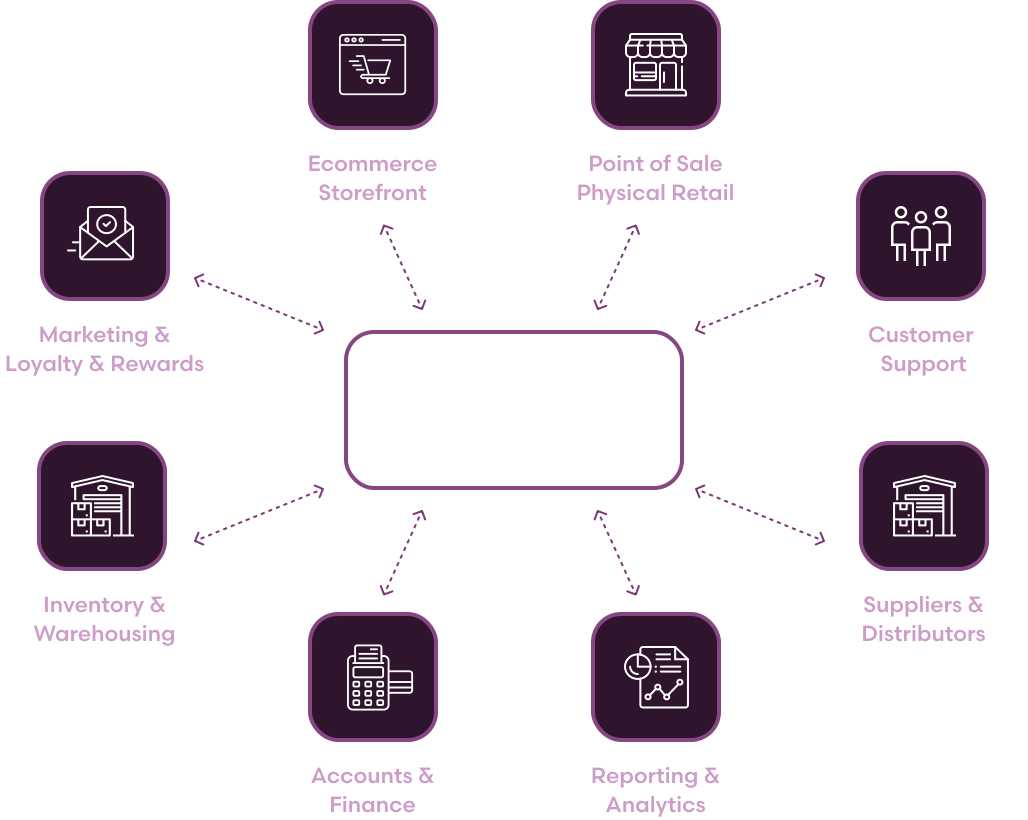
It brings the important workflows into one place, using the systems you already have as the foundation. Your ERP, POS, accounting, warehouse, ecommerce, and fulfilment platforms continue to do their jobs. Commerce Control connects the work between them.
That means your team has a clearer way to manage products, stock, orders, customers, reporting, fulfilment, and operational decisions without relying on disconnected spreadsheets and manual workarounds.
Connect what already exists.
Commerce Control does not replace your ERP, POS, accounting, warehouse, or ecommerce systems. It connects them, governs the workflows between them, and removes the spreadsheets, manual workarounds, and disconnected processes that slow the business down.
Visibility
Visibility, not just connection.
There are plenty of tools that can move data between systems. Zapier, n8n, Boomi, middleware, connectors, and custom integrations can all act as pipes.
They move information from one platform to another, but the data often still lives in separate systems. Shopify has one view. The ERP has another. The warehouse, POS, accounting, reporting, and marketing platforms each hold their own version of the truth.
That is connection, but it is not control. Commerce Control gives you visibility over the critical data from multiple systems in one place, so the business can understand what is happening and make informed decisions without waiting for exports, chasing updates, or comparing numbers across disconnected platforms.
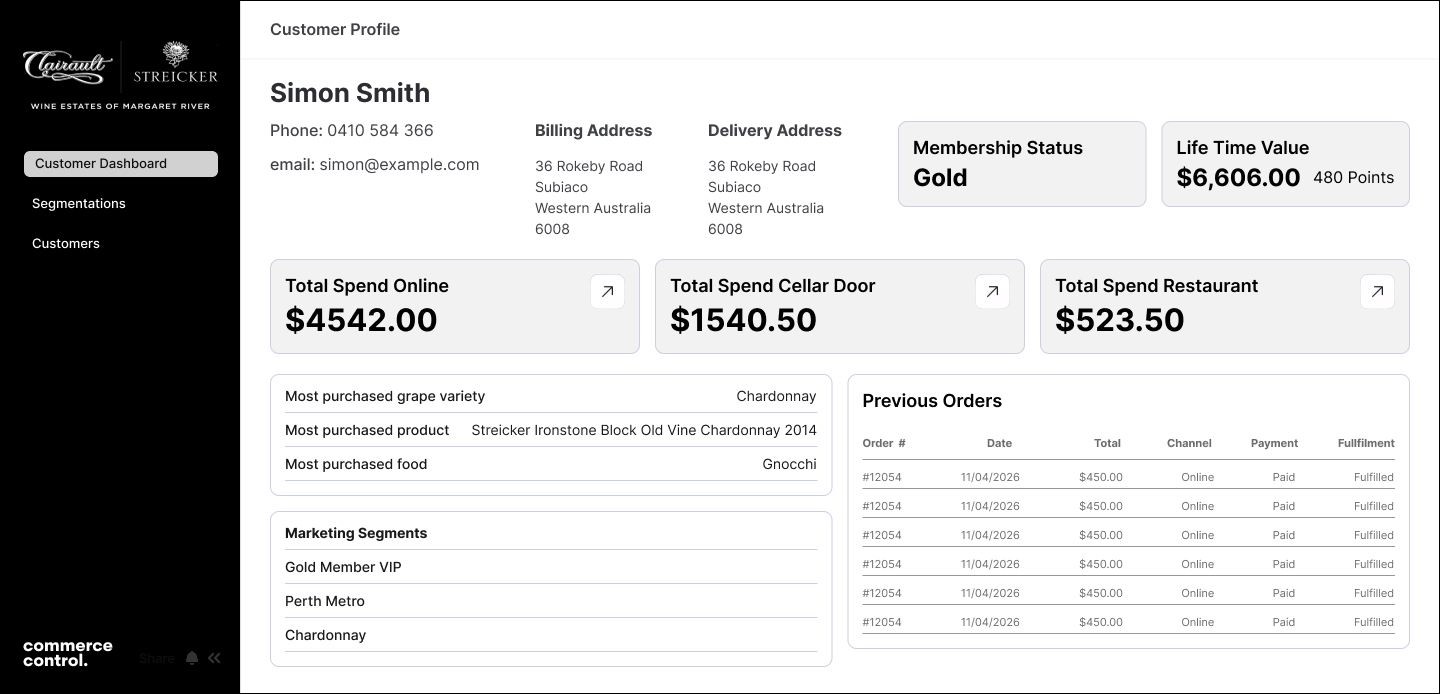
Customer visibility
Built to fit
Not another generic platform.
Most software is built for the average business. Your business is not average.
You have your own products, channels, customers, team structure, fulfilment model, reporting needs, supplier relationships, and operational edge. The system should fit that reality, not force your team into someone else’s workflow.
Commerce Control is built from a library of foundational modules developed by Cultivated Commerce, then selected, modified, and extended for your business.
Foundations before features.
A business cannot scale cleanly on messy data. Before we build screens, automations, dashboards, or AI tools, we define the foundations: product data, customer data, stock, orders, system roles, ownership, workflows, exceptions, and reporting logic.
Clean product data makes channel growth easier. Reliable stock data makes fulfilment and planning easier. Clear workflow ownership makes support easier. Structured operational data makes AI useful instead of noisy.
Product data, PIM workflows, enrichment, validation, and channel publishing.
ERP, POS, warehouse, fulfilment, accounting, and ecommerce system connections.
Inventory, order, customer, and fulfilment workflows.
B2B, wholesale, retail, POS, marketplace, and multi-location workflows.
Dashboards, reporting, monitoring, alerts, and exception visibility.
Operational tools for internal teams.
Workflow automation and approval processes.
Data structure that can support AI, forecasting, and better decision-making.
Documentation, training, QA, and operational handover.
What changes when Commerce Control is in place.
Commerce Control is the difference between a business held together by people doing heroic work, and a business with infrastructure that helps the team move with control.
Your team gets one place to work from.
Less chasing. Less spreadsheet wrangling. Less manual reconciliation. Fewer “who owns this?” moments. The people running the operation can see what needs attention, what has changed, and what needs to happen next.
Leadership gets visibility it can trust.
Instead of waiting for someone to pull data from five systems and explain why the numbers do not match, leadership gets clearer visibility into what is selling, what is in stock, what is moving, and what is at risk.
The business gets infrastructure that can scale.
New SKUs, suppliers, channels, locations, markets, and opportunities become easier to absorb because the operating foundation is already there.
Ready to build the system behind your growth?
Commerce Control starts with Commerce Clarity. We map the current state, define the future state, and confirm what needs to be built before anything is scoped, quoted, or implemented.